Table of Contents
Core Architecture Highlights
AutoTuner GUI v2.34.2 restructures runtime validation by moving cryptographic checksum checks and driver initialization into a hardened local enclave.
- Pre-authenticated local token caching authorizes read and write routines up to 72 continuous offline hours.
- High-rate CAN and CAN-FD telemetry streams record directly to NVMe storage without cloud sync bottlenecks.
- Integrated checksum calculation executes entirely on hardware coprocessors prior to sector flashing.
Local Cryptographic Caching & Workflow Decoupling
Operating diagnostic hardware inside Faraday-shielded dynamometer cells, remote race paddocks, and underground testing bays has long presented connectivity friction. In previous builds of the AutoTuner software suite, establishing an initial handshake with remote licensing servers was mandatory for every ECU read or write cycle. The introduction of GUI v2.34.2 addresses this limitation by deploying an encrypted token leasing model.
Under this mechanism, when the workstation establishes an authenticated session with the master servers, it leases an asymmetric key valid for up to 72 hours. During this leased window, the operator can disconnect the laptop entirely from Wi-Fi or cellular tethering. The local daemon verifies hardware serial numbers and protocol licenses internally, eliminating sudden aborts caused by intermittent latency spikes.
High-Frequency Sensor Logging & Data Safety
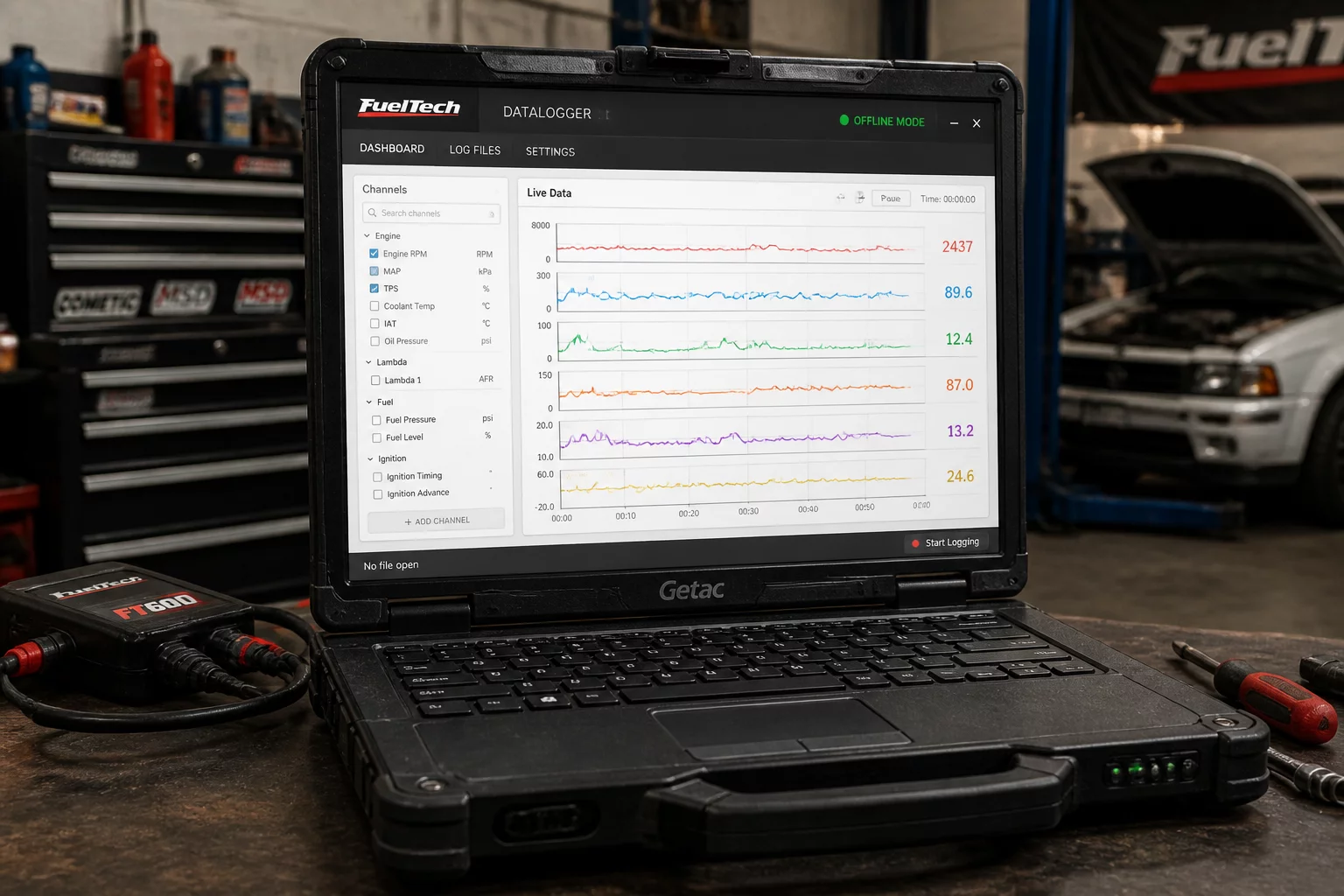
Beyond flashing capabilities, offline mode alters how high-bandwidth datalogs are structured. Instead of streaming active telemetry frames to cloud analytics dashboards in real time, the interface redirects high-frequency OBD-II and UDS queries directly to high-speed circular buffers on the host workstation. This architecture guarantees zero packet drop during wide-open-throttle calibration pulls.
Offline mode requires at least one full server handshake every 72 hours to refresh the cryptographic certificates and update local vehicle definition files.
In addition, the local integrity engine verifies flash binary signatures before initiating write sequences over the diagnostic bus. If battery voltage fluctuates or a communication timeout occurs during sector transfer, the software utilizes local boot recovery hooks without demanding an immediate cloud re-authorization session.
Hardware Verification & Technical Standards
Diagnostic benchmarks confirm timing stability and message integrity across various bus architectures during offline operations:
| Parameter | Diagnostic Specification | Verification Standard |
|---|---|---|
| Checksum Verification | Hardware Coprocessor SHA-256 Engine | ISO 14229 / UDS Standard |
| Buffer Cache Latency | < 1.4 ms Local NVMe Write Queue | SAE J1979-2 Compliance |
| Offline Session Window | 72 Hours Maximum Offline Authorization | AES-256 Rolling Token |
| Bus Recovery Mode | Active 12V / 24V Hardware Interlock | DIN 7637-2 Surge Protection |


Ray
Lead Diagnostic SpecialistOffline mode was really needed.