About LogContext Journal
LogContext Journal is an analytical engineering publication dedicated to transparent diagnostic logging, empirical baseline tracking, and disciplined automotive telemetry evaluation.
Sequential Log Documentation Workflow
Select any step in our standardized 6-phase review scenario to inspect required parameters, sensory inputs, and verification criteria.
Check Existing DTC Context
Review stored, pending, and permanent fault codes before data capture. Historical DTC logs provide essential baseline context, ensuring sensor fluctuations are correlated with onboard diagnostics rather than isolated as noise.
- » Scan all CAN-bus control modules for pending or history codes
- » Freeze-frame data timestamp alignment with vehicle operating hours
- » Clear differentiation between active hardware fault and transient signal loss
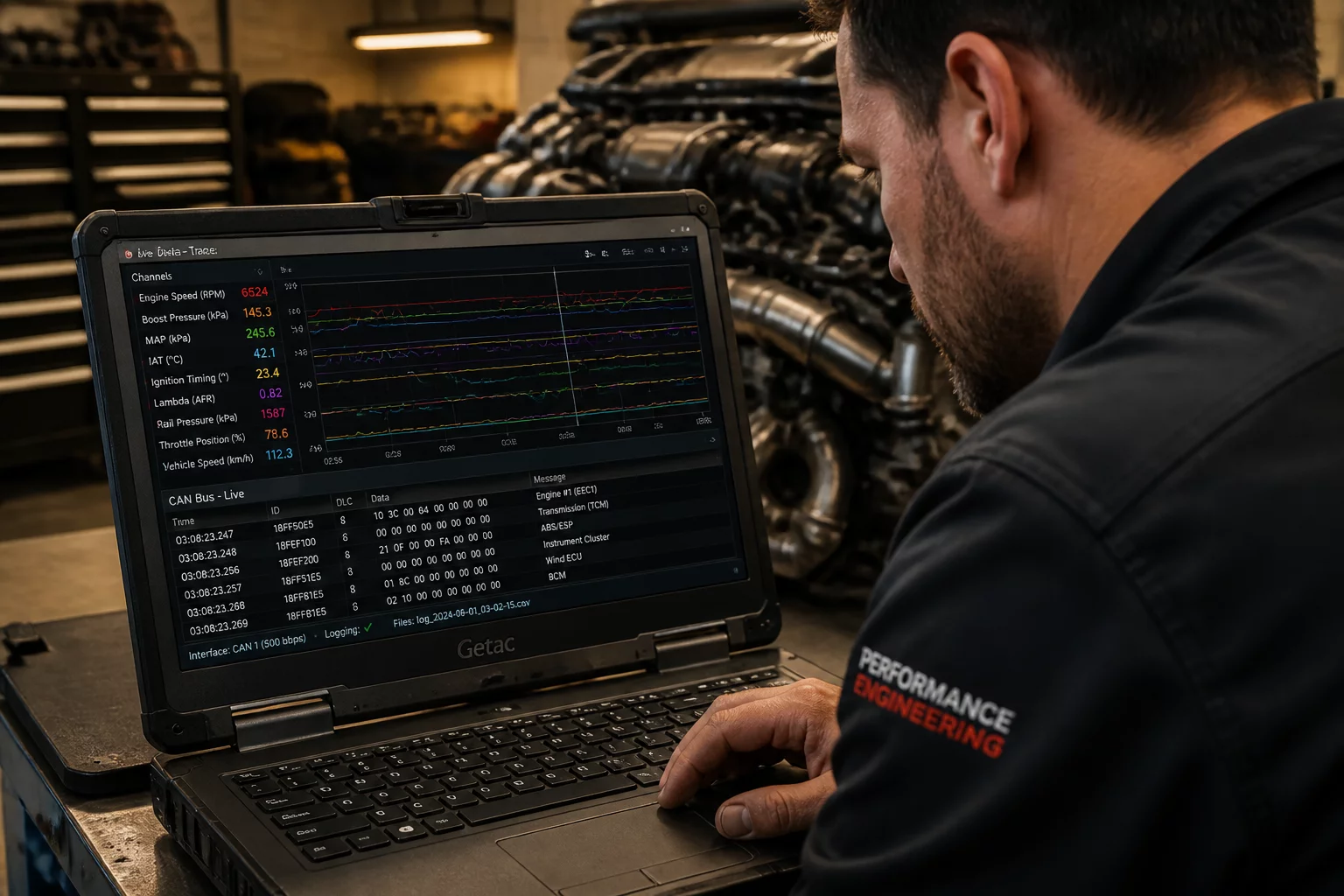
"Telemetry without environmental and mechanical context is merely random numbers. Accurate root-cause isolation requires exact repeatability of ambient temperature, fuel trim stability, and manifold absolute pressure baselines."
Stabilizing Sensor Baselines Before Acquisition
Before conducting dynamic capture runs, ensure the vehicle reaches closed-loop fuel status with stable coolant temperatures (85°C–95°C) and documented intake air temperatures. Unstabilized warm-up enrichments distort wideband oxygen sensor readings and mass airflow voltage baselines.
- » Document barometric pressure and ambient humidity prior to logging runs
- » Confirm short-term and long-term fuel trims remain within ±5% of equilibrium
- » Verify steady alternator voltage output above 13.8V across varied auxiliary loads
Interactive Telemetry Context Evaluator
Simulate how contextual variables change diagnostic interpretation. Choose an operating condition scenario below to examine live calculated deviations.
Select Scenario
Higher calculated engine load paired with lower manifold pressure confirms physical mass air escape downstream of compressor housing.
Intake Track Pressure Leak (MAF Divergence)
Analytical Context Review:
The mass airflow sensor measures air entering the intake tube, injecting fuel accordingly. However, lost charge air downstream creates an excessively rich air-fuel mixture, forcing ECU oxygen feedback trim deeply negative during steady throttle cruise.