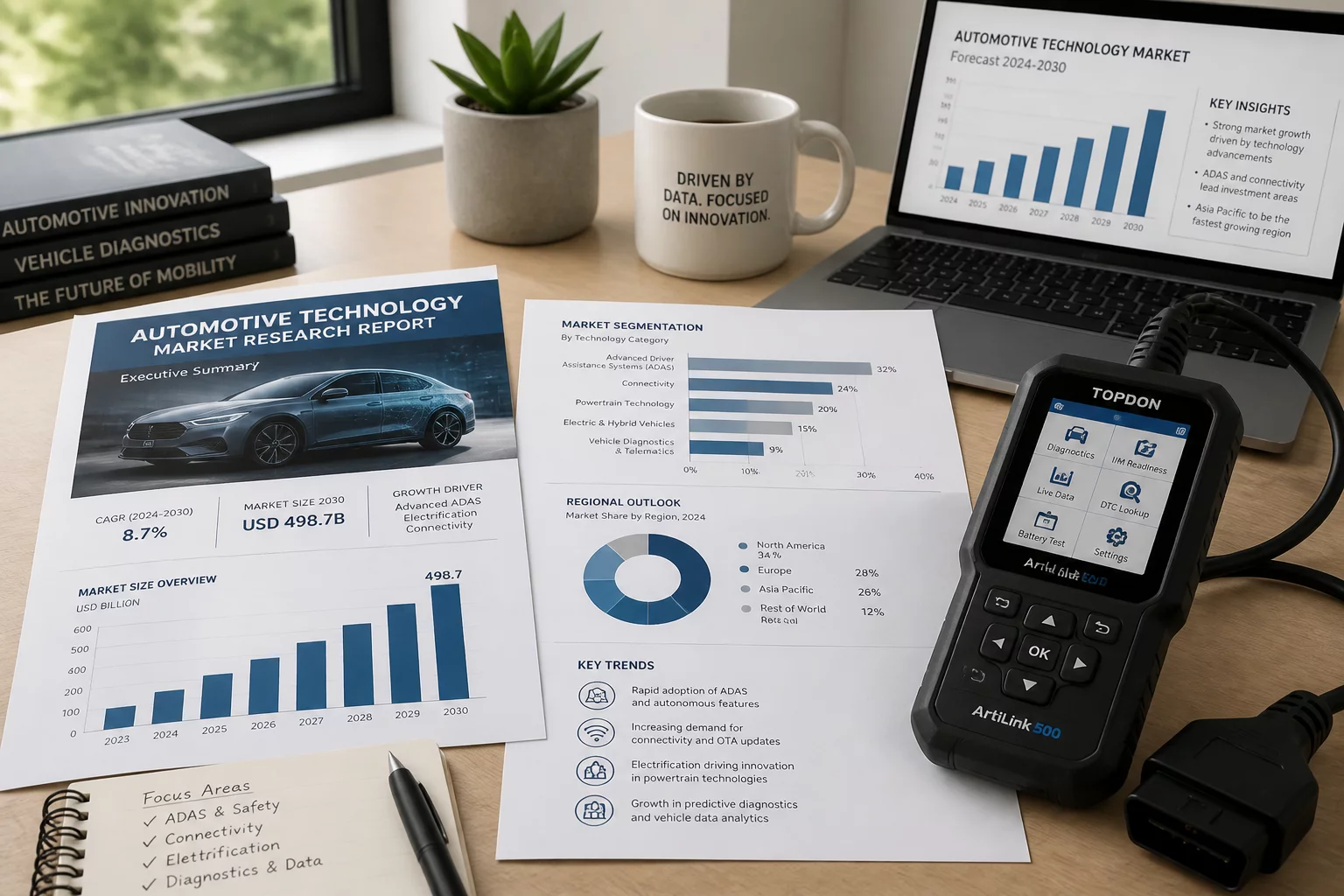
Diagnostic Scanner Market Dynamics: Protocol Demands & Hardware Evolution
Precedence Research recently published its comprehensive market study examining the global trajectory of automotive diagnostic scanners and workshop data interfaces through the current decade. The report documents an accelerating transition away from legacy, slow-bandwidth scan tools toward modular, high-throughput hardware capable of handling modern vehicle network complexities. With software-defined vehicles dominating OEM production lines, technicians face a diagnostic environment requiring multi-channel capture, cloud synchronization, and complex gateway authentication.
Modern repair workflows no longer rely purely on basic fault code extraction. Instead, shops require rapid telemetry decoding, continuous parameter recording, and bi-directional test routines capable of communicating over heterogeneous bus systems. The market analysis underlines how commercial repair facilities prioritize scan platforms that combine classic OBD-II compliance with next-generation communication bridges.
Evaluating Interface Throughput and Bus Architecture Support
When choosing modern diagnostic hardware, physical bus capability stands out as the fundamental selection metric. As vehicles implement Controller Area Network with Flexible Data-Rate (CAN FD) and Diagnostic Communication over Internet Protocol (DoIP), older microcontrollers suffer frame drops and incomplete log traces. The Precedence Research report emphasizes that diagnostic platforms featuring reconfigurable FPGA or dual-core ARM processors deliver the steady timing needed for uninterrupted live-data evaluation.
Peer Discussion & Technical Notes
No comments yet. Be the first to share a technical note or observation.
Leave a Peer Technical Comment