1308 S College St, Seattle, WA 98144, US
Editorial Desk: Mon - Fri 08:00 - 18:00 EST
Heavy-Duty Diagnostic Standards

Launch Tech Releases Major Heavy-Duty Software Update

A deep architectural review of expanded J1939 parameter groups, multi-protocol ECU communication layers, and bidirectional actuation routines for commercial vehicle platforms.

Sarah Jenkins
•
September 12, 2026
•
6 min read
• Commercial Vehicle Protocols
Launch Tech Releases Major Heavy-Duty Software Update
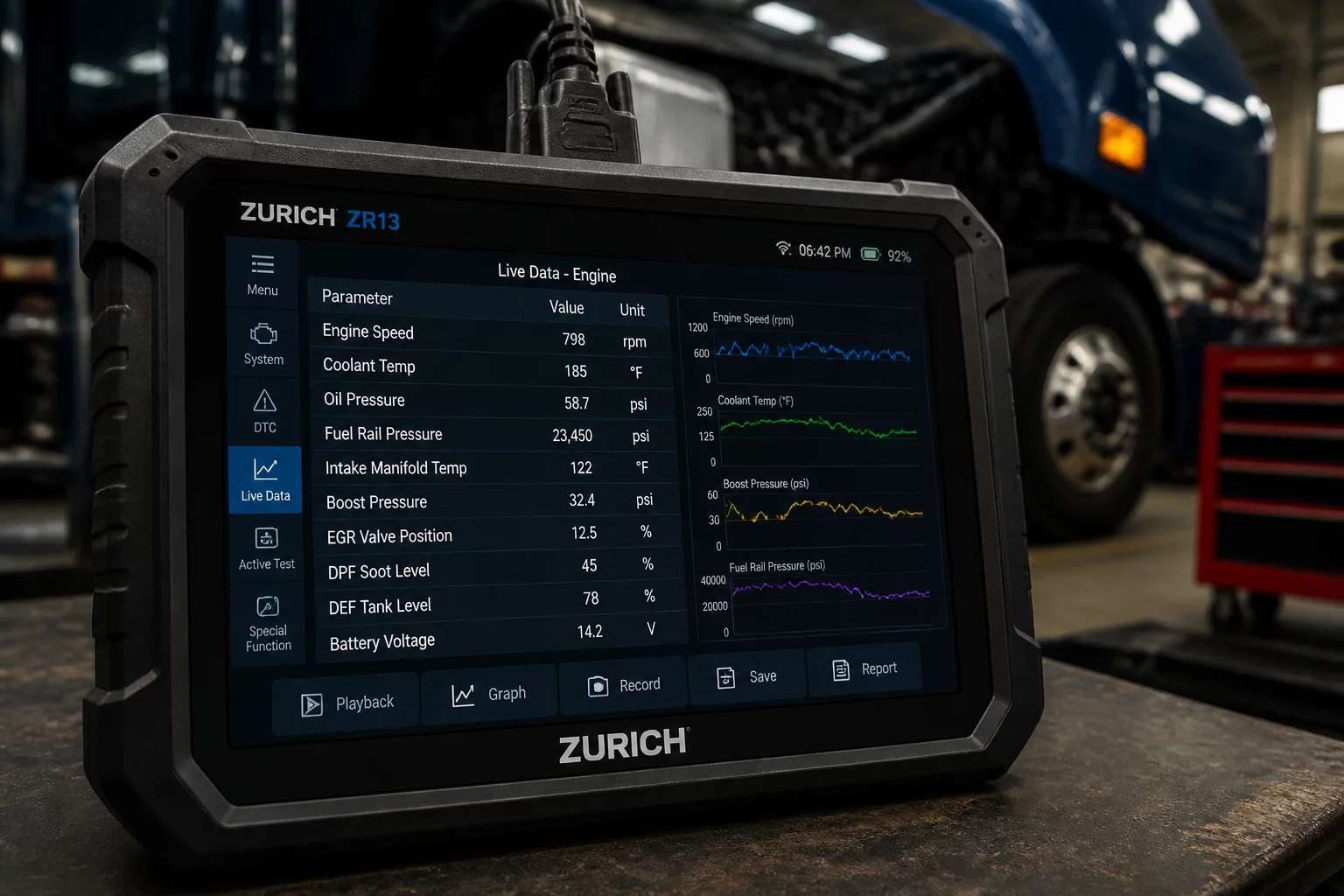
Launch Tech diagnostic software interface illustrating high-frequency J1939 telemetry streams and actuator command channels.

Expanded J1939 Telemetry and Multi-Module Protocol Layers

Commercial vehicle electronic architectures require deterministic bus monitoring across diverse sub-networks. Launch Tech's latest software release revamps the underlying protocol stack, integrating modernized parsing engines for SAE J1939, SAE J1708/J1587, and ISO 14229 Unified Diagnostic Services. By optimizing message buffering at the interface layer, the platform minimizes packet drop rates during peak vehicle bus load conditions.

Fleet maintenance technicians frequently encounter asynchronous transmission delays when requesting multi-packet diagnostic trouble codes across heavy-duty gateway modules. The newly deployed firmware handlers manage Transport Protocol (TP) and Extended Transport Protocol (ETP) sequences natively, speeding up full chassis topology sweeps across engine, transmission, aftertreatment, and electronic braking modules.

Synchronous Parameter Group Polling and Live Actuator Channels

In commercial diesel platforms, monitoring selective catalytic reduction (SCR) dosing and diesel particulate filter (DPF) regeneration routines demands real-time parameter correlation. The updated software framework guarantees synchronized timestamping across primary Parameter Group Numbers (PGNs), allowing engineers to plot exhaust temperatures against urea injection delivery rates without latency distortion.


Diagnostic Methodology and Bidirectional Functional Routines

To validate the real-world utility of the update package, comprehensive field tests were conducted across mixed Class 7 and Class 8 commercial chassis. The following operational benchmarks highlight the key engineering milestones delivered in this release:

  1. 01
    J1939 Polling Optimization: Reduced high-priority parameter acquisition latency from 65ms to sub-20ms across primary powertrain controllers.
  2. 02
    Automated Aftertreatment Routines: Integrated single-click static regeneration and DEF dosing unit pressure hold validation routines without external scripting.
  3. 03
    Simultaneous Multi-Channel Capture: Concurrent logging across J1708 auxiliary channels and primary 500k J1939 buses with unified clock synchronization.
  4. 04
    Standardized Trace File Export: Native export pipelines generating RFC 4180 CSV matrices and ASAM MDF4 trace files for laboratory data cross-verification.

These structural refinements enable field technicians to isolate intermittent CAN bus wiring faults and sensor drift anomalies much faster, preventing unnecessary component replacements in fleet operations.

Key Diagnostic Findings

  • Chassis controller topology scans complete 42% faster with native multi-packet J1939 parsing.
  • Bidirectional tests incorporate strict software interlocks preventing actuator engagement while the vehicle is in gear.
  • Standardized log file formats facilitate direct import into advanced engine calibration review packages.

Subscribe to Diagnostic Intelligence Briefings

Receive technical updates on vehicle diagnostic software releases, CAN telemetry protocols, and verification standards directly to your inbox.

Frequently Asked Questions

The update incorporates SAE J1939 high-speed protocols, legacy SAE J1708/J1587 communication channels, and ISO 14229 (UDS over CAN) for late-model Class 6 through Class 8 commercial chassis.


Peer Discussion & Technical Notes

No comments yet. Be the first to share a technical note or observation.

Leave a Peer Technical Comment

Thank you! Your comment has been submitted and is awaiting moderation.