1308 S College St, Seattle, WA 98144, US
Editorial Desk: Mon - Fri 08:00 - 18:00 EST
Industry Research & Protocol Standards

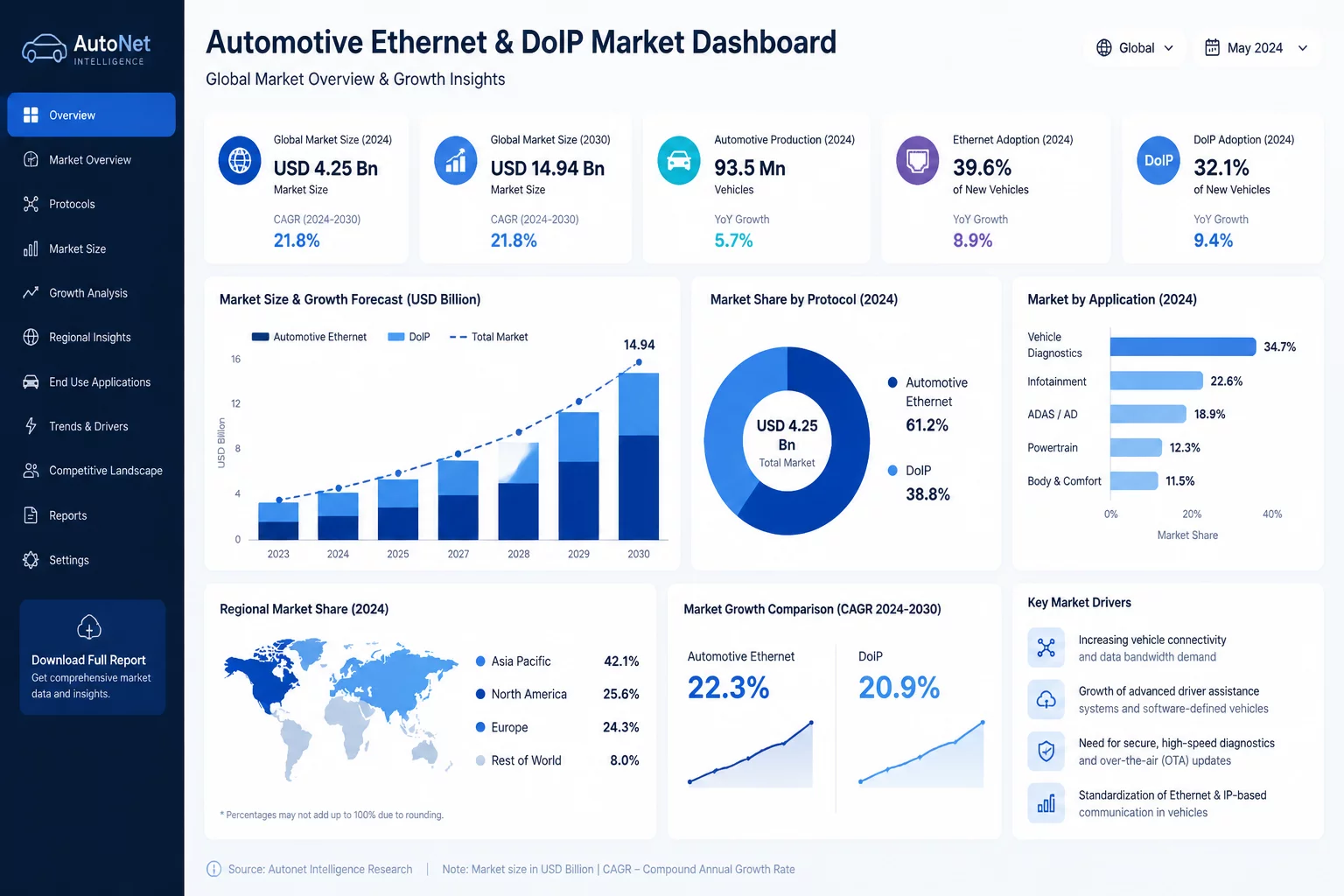
Dataintelo Publishes Market Report on DoIP Protocol Stacks

Comprehensive evaluation of ISO 13400 software stack adoption across next-generation automotive Ethernet architectures

Christopher Jackson
•
May 28, 2026
•
6 min read
• DoIP Integration
Dataintelo Publishes Market Report on DoIP Protocol Stacks
Global growth projection and deployment matrix for embedded Diagnostic over Internet Protocol (DoIP) software stacks.

Shift Toward Automotive Ethernet & Standardized Stacks

Market research firm Dataintelo released its global assessment of the Diagnostics over Internet Protocol (DoIP) protocol stack sector, tracking OEM migration away from legacy controller area network buses toward high-bandwidth Ethernet backbones. Modern vehicle platforms demand rapid firmware transmission, complex telemetry monitoring, and secure remote diagnostic capabilities that traditional CAN FD channels struggle to sustain.

Standardized under ISO 13400, DoIP establishes a deterministic transport layer above TCP/IP, allowing diagnostic testers to communicate with internal electronic control units at transmission rates exceeding 100 Mbps to 1 Gbps. The report underscores that commercial protocol stack licensing has grown rapidly as automotive software suppliers prioritize AUTOSAR-compliant stacks that reduce custom software development cycles.

Impact on Diagnostic Tooling and Workshop Workflows

Independent workshops and diagnostic hardware manufacturers are concurrently upgrading physical vehicle communication interfaces (VCIs) to incorporate Ethernet PHY hardware. The transition enables comprehensive multi-ECU flash reprogramming routines to complete in minutes rather than hours, altering the operational cadence of field diagnostics.


Core Technical Dimensions Highlighted in the Report

The Dataintelo research highlights four pivotal technology requirements driving DoIP protocol stack selection among tier-1 suppliers and diagnostic developers:

  1. 01
    AUTOSAR Classic & Adaptive Compatibility Protocol stacks must interface cleanly with service-oriented architecture (SOA) middleware without introducing routing latency or memory leakage in resource-constrained ECUs.
  2. 02
    TLS 1.3 Cryptographic Handshake Integration Compliance with modern UNECE cybersecurity mandates requires embedded Transport Layer Security (TLS) acceleration directly within the DoIP stack wrapper.
  3. 03
    High-Throughput Parallel ECU Flashing Modern stacks support concurrent TCP sessions to broadcast payload data simultaneously across central gateway and domain controllers.
  4. 04
    Hardware-Agnostic Socket Abstraction Engineers increasingly demand hardware abstraction layers (HAL) that allow identical DoIP binaries to operate on both ARM-based microcontrollers and x86 test benches.

As vehicle architectures centralize around zonal compute clusters, embedded DoIP stacks function as the primary ingress point for both factory-floor provisioning and aftermarket maintenance suites.

Report Summary & Practical Conclusions

  • DoIP adoption has shifted from premium electric architectures into volume passenger and commercial vehicle platforms.
  • Commercial software stacks minimize OEM integration overhead while meeting strict ISO 13400-2 conformance criteria.
  • Aftermarket diagnostic scanners must natively support automotive Ethernet pinouts to maintain full scan tool capability.

Stay Informed on Diagnostic Standards

Subscribe to receive curated monthly technical briefs on ISO 13400 implementations, OBD regulations, and telematics protocols.

Frequently Asked Questions

DoIP operates over standard Ethernet wiring with bandwidth reaching 100 Mbps or higher, compared to CAN FD which caps out around 5 to 8 Mbps. This speed difference allows rapid flashing of multi-gigabyte software packages across modern vehicle domains.


Peer Discussion & Technical Notes

No comments yet. Be the first to share a technical note or observation.

Leave a Peer Technical Comment

Thank you! Your comment has been submitted and is awaiting moderation.