Bus Evolution: The Shift to Flexible Data-Rate and Automotive Ethernet
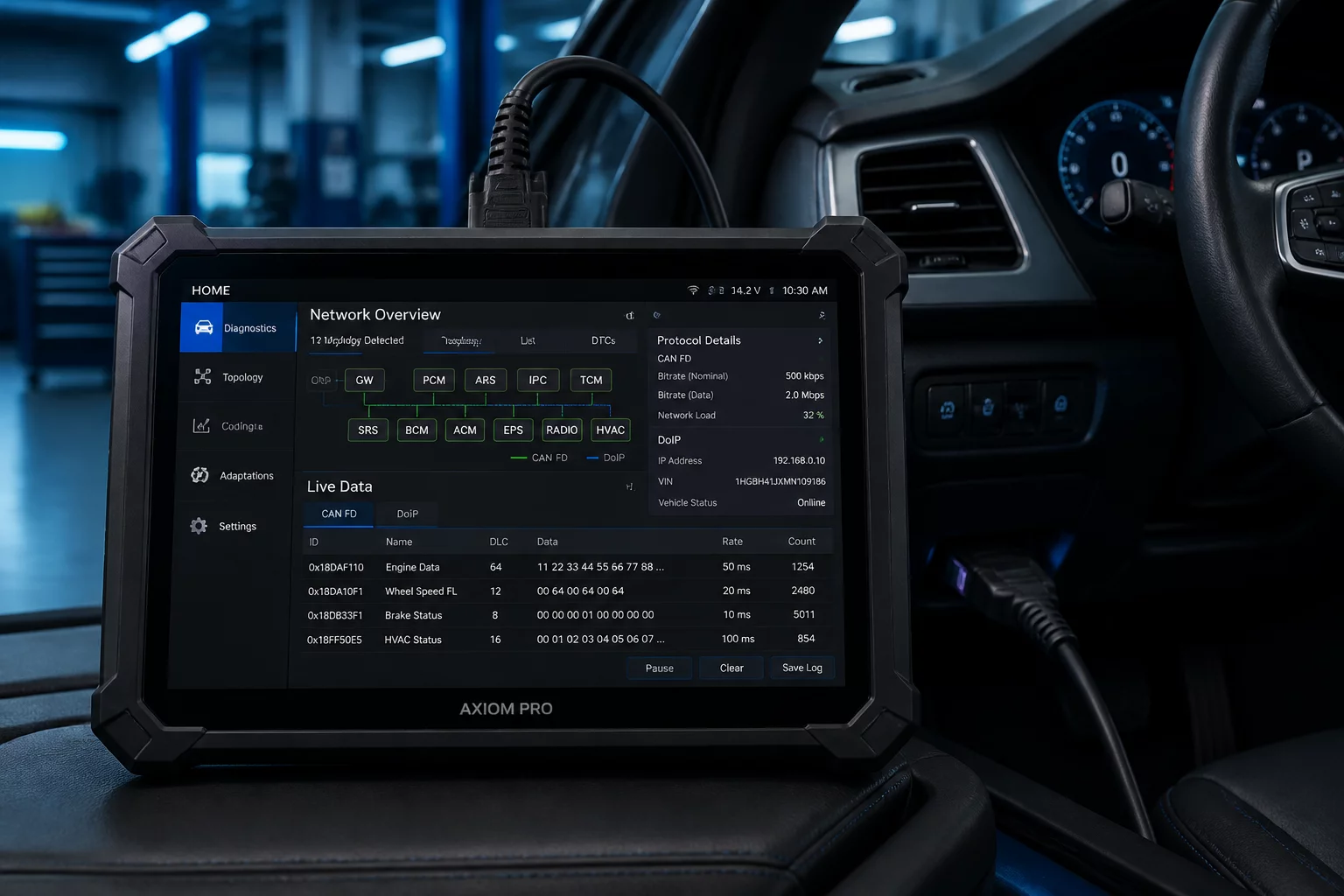
Modern vehicle network topologies have rapidly outgrown the bandwidth constraints of standard High-Speed Controller Area Network (HS-CAN 2.0B) operating at 500 kbps. The widespread deployment of centralized domain controllers, multi-sensor ADAS platforms, and unified zonal architectures demands diagnostic throughputs capable of handling complex payload packets without queuing delays or buffer overruns. Autel's recent revision of its professional diagnostic tablet line directly addresses this structural shift by integrating dedicated CAN FD and Diagnostics over Internet Protocol (DoIP) physical transceiver chips directly into the Vehicle Communication Interface (VCI) modules.
Previously, workshop technicians were forced to rely on external inline CAN FD adapters or secondary Ethernet breakout leads to interface with newer vehicle platforms from General Motors (Global B architecture), Ford, Stellantis, BMW, and Jaguar Land Rover. The internal hardware redesign replaces these auxiliary adapters with high-speed analog multiplexing matrices, hardware-level arbitration controllers, and direct ISO 13400 Ethernet transceivers capable of automated pin routing right at the OBD-II 16-pin connector interface.
Eliminating Communication Bottlenecks in Secure Gateway Interfacing
Integrating native CAN FD transceivers expands the payload field from 8 bytes to 64 bytes per frame while raising the dynamic data transmission bit rate up to 5 Mbps during the payload transmission phase. Combined with DoIP support operating at 100BASE-T1 / 100BASE-TX over ISO 13400 standards, flash programming times and high-density telemetry recording cycles for multi-channel sensor logs show latency reductions exceeding 70% in controlled laboratory bench trials.
Peer Discussion & Technical Notes
No comments yet. Be the first to share a technical note or observation.
Leave a Peer Technical Comment