1. The Question
Can a second reviewer reconstruct what this session was for without asking the person who recorded it?
A fleet workshop inherited a folder of logs from a departing technician. The files were complete and well-organised — and almost entirely unusable. No questions, no conditions, no window markers. The handoff note for each was a filename.
The archive failed a test nobody had designed for it: could a stranger pick up a file and know what it was for? Filenames like 'Thurs_morning_pull.csv' carried everything the original technician needed and nothing anyone else could use.
Institutional memory is personal memory until it is written down. The moment the person who remembers leaves — or simply forgets — undocumented logs depreciate from evidence to storage costs.
2. The Vehicle State
The logs covered four vehicles across two model lines. Filenames encoded dates but not VINs, states, or session purposes.
Untraceable vehicle state turned a shared archive into a private memory that had already left the company.
Cross-referencing dates against job cards recovered vehicle identities for some files, at a cost of hours per log. VIN, odometer, and service state — one line each — would have made that archaeology unnecessary.
Vehicle state anchors a file in the physical world. Without it, two identical model-line logs are indistinguishable, and a 'fleet pattern' can be nothing more than the same car recorded twice.
3. The Conditions
None of the sessions carried condition notes. Some filenames hinted at weather; most did not.
The archive recorded what the sensors saw and nothing about the world they saw it in.
Some context could be reverse-engineered — a timestamp plus weather records hinted at ambient — but inferred conditions carry the same uncertainty as guessing. Every inference is a new chance to be wrong.
The deeper issue is that conditions were never treated as data. Sensors logged channels; nobody logged the world the channels measured. An archive of pure signal and no circumstance is an archive of puzzles.
4. The Recorded Window
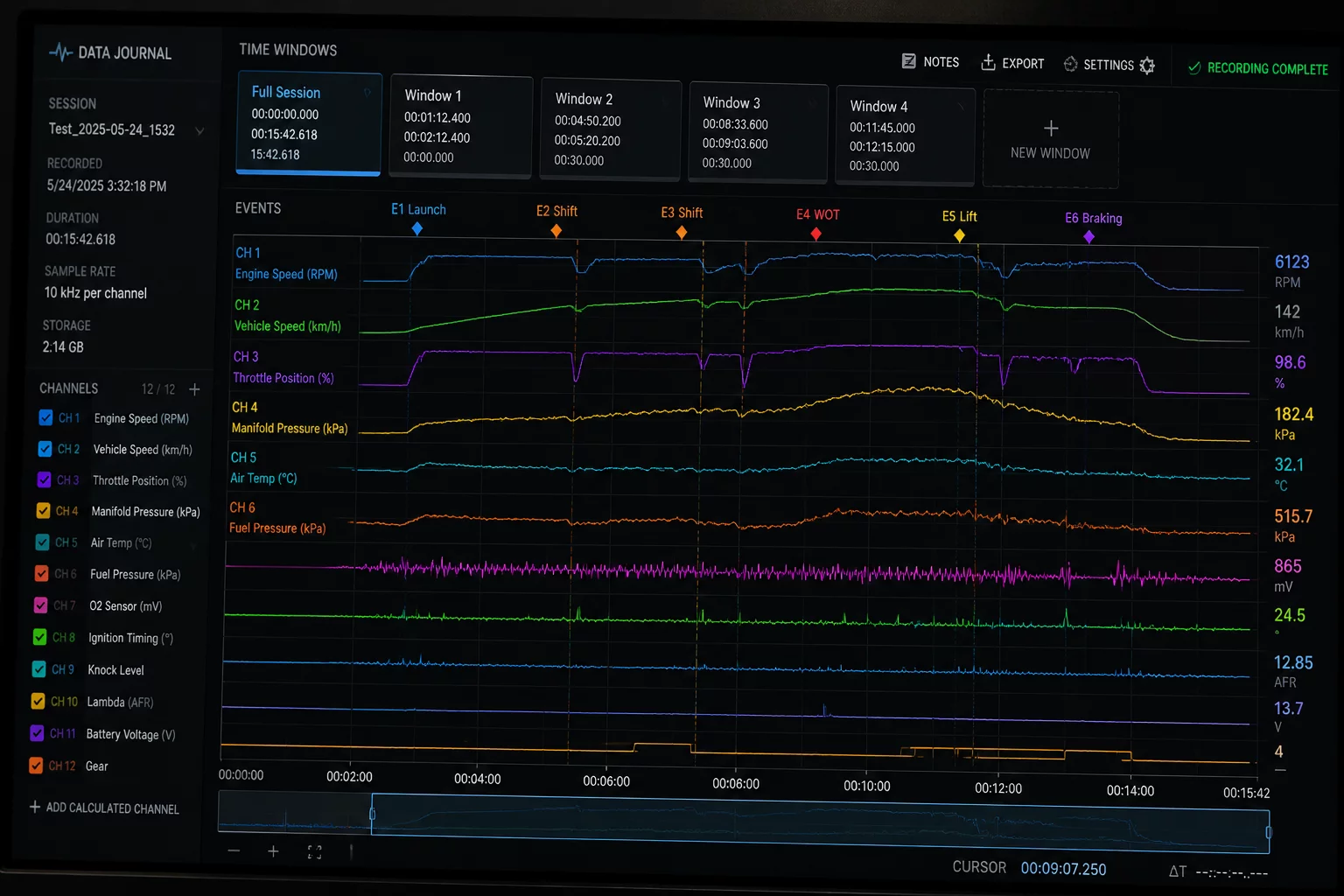
The files were timestamped but unmarked — no event flags, no indicated regions of interest.
Every future reviewer would have to rediscover the interesting minutes alone.
Unmarked windows tax every future reader the full cost of discovery. A file that took eleven minutes to record took forty to re-review — and that multiplier applies to every person who ever opens it.
Markers and regions of interest are how a session speaks to its future readers. Even a single flag — 'the interesting bit is here' — is a message worth sending.
5. The Observation
A pilot re-review of three files took longer than the original sessions had. One file yielded a usable conclusion only because a phone photo of the dashboard happened to survive.
The data survived the handoff. The context did not.
The pilot re-review quantified the loss: three files, roughly two hours of senior-technician time, one usable conclusion — and that one only because a phone photo happened to supply the missing context.
The photo is the cautionary part of the story. Context existed — it just lived on a personal phone instead of beside the file. Survival of context by accident is not a documentation strategy.
6. The Follow-Up Question
Attach a Log Context Sheet to every archived session: question, vehicle state, conditions, recorded window, observation, and the follow-up question it raised.
The next reviewer — who may be you in six months — inherits an investigation, not a puzzle.
The fix is procedural, not technical: a Log Context Sheet attached to every archived session — question, vehicle state, conditions, marked window, observation, and the follow-up question it raised. Six fields, two minutes, permanent interpretability.
The next reviewer is usually you, six months later, with none of the memory and all of the files. Write the handoff note for that person — they are the least informed reviewer the log will ever meet.
What was happening when this data was recorded? If the sheet cannot answer that, the log is not evidence yet — it is just a file.— Marcus Vance, LogContext Journal
Comments & Verification Notes
No peer comments recorded yet. Be the first to submit a technical note.