1. The Question
Why does the temperature reading spike only when the vehicle is left idling after a highway run?
The owner captured three separate logs — each started once the gauge already looked wrong. Every file showed a stable, slightly elevated reading and nothing else. The transition that mattered happened in the minutes before the record button was pressed.
The owner had done the hard part right: three separate recordings, consistent conditions, steady-state capture. What failed was timing. Each file documented the plateau after the spike, not the climb that produced it.
The question being asked — 'why does it spike after a highway run?' — is a transition question. Transitions live at the start of sequences, and starting the recording after parking guarantees the interesting part is already over.
2. The Vehicle State
2015 diesel wagon, 146,000 km, factory cooling system. Electric fan operation was audible in the logs but its duty cycle was not among the recorded channels.
The channel list was chosen for the symptoms, not for the question — the trigger signal was missing entirely.
On a 146,000 km diesel, post-load heat soak is a real thermal phenomenon, not an anomaly — the question is whether its magnitude is normal. Answering that needs the climb, the fan response, and the rate of rise, none of which a plateau shows.
The missing fan channel was the subtler error. Symptom channels describe the complaint; trigger channels describe the mechanism. A recording that captures only symptoms can confirm them but never explain them.
3. The Conditions
All three attempts were recorded in a driveway after the same commute. Ambient conditions were documented; the drive home that produced the heat soak was not.
The logged minutes were consistent. The unlogged minutes were the whole story.
Driveway conditions were well documented — ambient, wind, parking orientation — but they are the conditions of the aftermath. The commute that built the heat went unrecorded: duration, load profile, and the last ten minutes of driving that set the thermal state.
Conditions upstream of the window often matter more than conditions inside it. For heat soak especially, the question 'what did the last fifteen minutes look like?' outweighs anything measurable in the driveway.
4. The Recorded Window
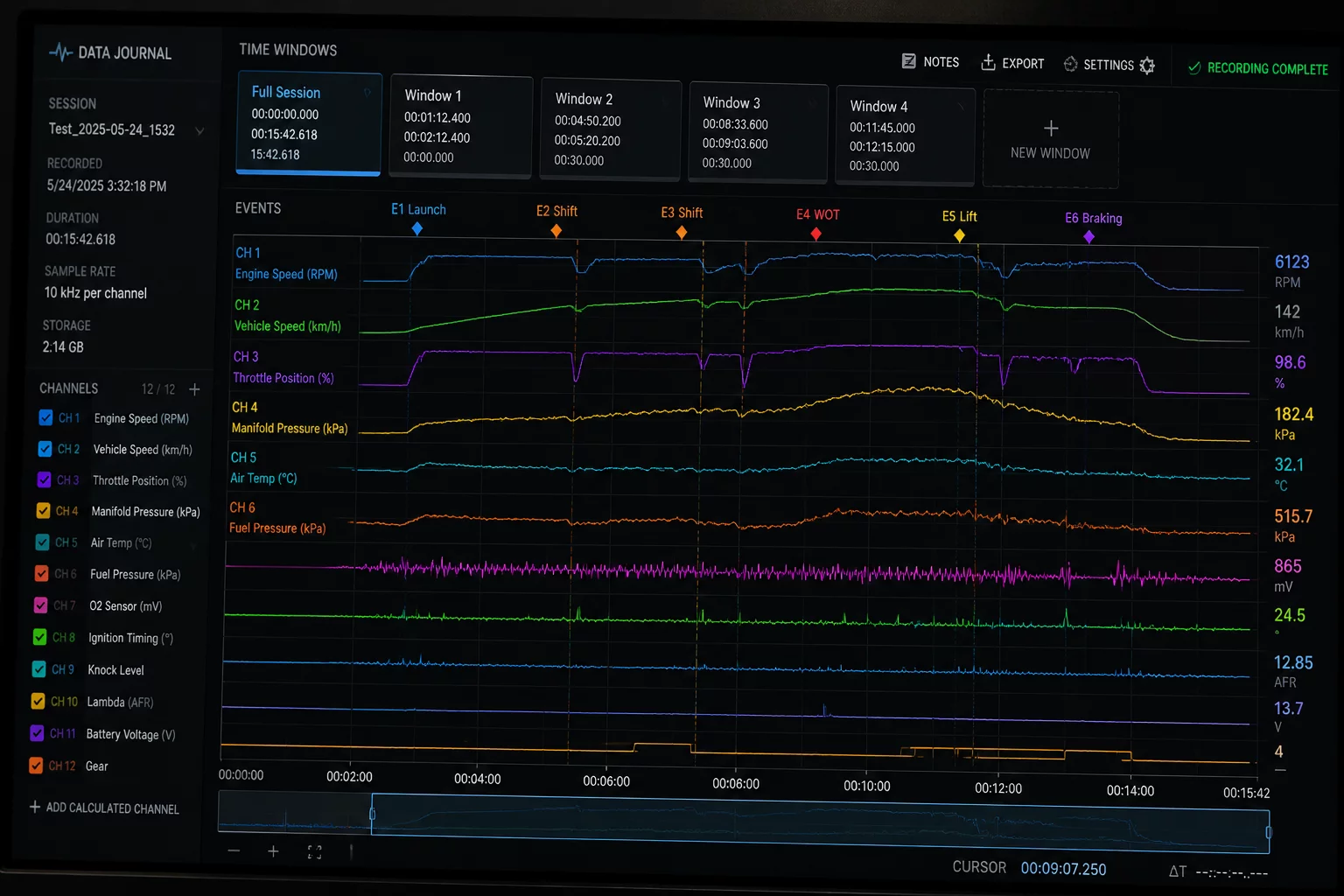
Each recording covered roughly three minutes of post-drive idle. The heat-soak transition the owner described occurred during the two to three minutes between parking and pressing record.
The window captured the aftermath with forensic precision.
Three minutes of post-drive idle is a fine window for a steady-state question and a useless one for a transition question. The file proved the symptom existed and was stable — which was already known — while the causal interval sat unrecorded in the two minutes before 'record' was pressed.
Rolling buffers exist for exactly this. Starting capture before the trigger, or keeping the last minutes of driving in buffer, moves the event inside the window instead of letting it escape through the gap between parking and recording.
5. The Observation
Three files, three clean captures, zero usable transitions. The logs proved the symptom was stable — which the owner already knew.
The data was flawless and the evidence was absent.
Three files of identical, stable elevation are evidence of stability — and nothing else. They answer a question nobody asked ('is it steady once elevated?') and leave the real one untouched.
This is the most expensive kind of bad data: technically perfect, methodically consistent, and aimed at the wrong interval. The files did not fail; the timing did.
6. The Follow-Up Question
Start recording before the event can happen — a rolling buffer or a pre-drive start — and include the trigger channels, not just the symptom channels.
The fourth session began on the on-ramp. The spike appeared at minute fourteen, in context, with the fan channel visible.
The corrected protocol moved the record start to the on-ramp and added the fan-duty channel to the list. The transition appeared at minute fourteen — climb rate, fan engagement point, and plateau all in one continuous window.
For transition questions, the rule is simple: the record button must precede the suspected trigger, not the symptom. If you cannot predict when to start, you need a buffer, not faster fingers.
What was happening when this data was recorded? If the sheet cannot answer that, the log is not evidence yet — it is just a file.— Devon Bradley, LogContext Journal
Comments & Verification Notes
No peer comments recorded yet. Be the first to submit a technical note.